Saturday, March 19, 2011
Carver Middle High School - March 25
41° 53' 31" N
70° 45' 11" W
See the Steve Morse lat/long finder to look up other addresses, or read the EarthView lat/long article for much more graticular information!
As Principal Scott Knief recently wrote, the school's mission includes helping students to meet “the changing needs and increased expectations of our town, our state, and our global society.” EarthView's return to Carver -- this is our third or fourth visit -- is intended to help further this goal. By being more aware of how they fit into a global context, students in Carver -- or anywhere -- will be better prepared for future careers and participation in civic life.
It seems that recent events -- especially in North Africa and Japan -- are reminding us all of the importance of those global connections. We encourage students to examine recent blog posts to continue learning about some of the concepts we share during our all-too-brief EarthView programs.
This visit coincides with a very important anniversary in the history of education. On March 25, 1845, the Massachusetts legislature voted to ensure that all children in the Commonwealth would have access to public schools, regardless of race. The story of the determined parents of Nantucket is told on this date's Mass Moments.
70° 45' 11" W
See the Steve Morse lat/long finder to look up other addresses, or read the EarthView lat/long article for much more graticular information!
As Principal Scott Knief recently wrote, the school's mission includes helping students to meet “the changing needs and increased expectations of our town, our state, and our global society.” EarthView's return to Carver -- this is our third or fourth visit -- is intended to help further this goal. By being more aware of how they fit into a global context, students in Carver -- or anywhere -- will be better prepared for future careers and participation in civic life.
It seems that recent events -- especially in North Africa and Japan -- are reminding us all of the importance of those global connections. We encourage students to examine recent blog posts to continue learning about some of the concepts we share during our all-too-brief EarthView programs.
This visit coincides with a very important anniversary in the history of education. On March 25, 1845, the Massachusetts legislature voted to ensure that all children in the Commonwealth would have access to public schools, regardless of race. The story of the determined parents of Nantucket is told on this date's Mass Moments.
Wednesday, March 16, 2011
Mashpee Middle School -- March 18
41° 36' 57" N70° 30' 34" W
Learn more about Lat/LongThe EarthView Team is pleased to be visiting Mashpee Middle School in the Cape Cod town of Mashpee. Members of the BSU geography department have been learning about the geography of Mashpee from a Wampanoag perspective during recent field trips.
![]() |
| Map from the indigenous learning tools at ECHO Space |
As geographers, we are delighted to see that the town web site makes it very easy to explore Mashpee through GIS. The map of the school property below was prepared in a matter of seconds. It highlights the school property in the context of surrounding land use, and indicates the presence of wetlands. Use Mashpee's Public Maps Online site to create maps of your neighborhood or the entire town!
Our visit coincides with the anniversary of Johnny Appleseed's death in 1845. He was a real person, and he was from Massachusetts. Read about the legend and the fascinating realities of the real John Chapman on Mass Moments. Many other interesting events took place on this date, including Britain's repeal of the Stamp Act (1766) and the Gardner art theft in Boston (1990 -- still the greatest art theft ever).
Tuesday, March 15, 2011
Mullein Hill Christian Academy -- March 15
41° 48' 39" N70° 58' 32" W
Learn more about Lat/LongEarthView returns to Mullein Hill Christian Academy, a small school in Lakeville. As with a previous visit, BSU students in my (Dr. Hayes-Bohanan's) course for future geography teachers will participate in the program.
I have enjoyed a number of geographic connections in Lakeville since coming to this area in 1997. One of the first online education projects I did (with the help of some geography students) was a simple web site about the bald eagles that nest at Assowompsett Pond, just 2-3 miles northeast of the Academy. In order to protect water resources in Lakeville for the benefit of New Bedford and Taunton, habitat has been made available to the eagles.
View Larger Map
Because of my interest in the geography of coffee -- including the ways that local coffee shops can be part of a community -- I have been very interested in Somethin's Brewin' Book Cafe, also in Lakeville. The cafe uses the town's former library, which is a beautiful example of an historic Carnegie Library -- one of 2,509 built throughout the world.
The relationship between humans and the environment is an important aspect of geography, and Stephanie's Perennials in Lakeville is a local business that helps people in the area improve that relationship by taking better care of gardens and landscaping.
Geography education is important at Mullein Hill, and I remember being impressed with how much students understood during our previous EarthView program there. The school web site sets a good example, by including an embedded map on the contact page of its web site.
This visit to Mullein Hill Christian Academy coincides with a geographic anniversary that is important for our region. From the 1647 until March 15, 1820, Maine was administered as a territory of Massachusetts. In fact, following the Revolutionary War, much of that territory was settled by Bay Staters whose land purchases helped to pay down the Commonwealth's war debts. On this date in 1820, however, Maine became an independent state, as part of the Missouri Compromise.
Monday, March 14, 2011
East Taunton Elementary, March 14
41° 52' 22" N71° 02' 41" W
Learn more about Lat/LongMs. Hill is a student teacher working with Mrs. Majkut's third-grade class at East Taunton Elementary. She was also a student of Dr. Domingo and Dr. Hayes-Bohanan of the EarthView team several years back, when they first became aware of EarthView. It was a delight, therefore, to bring EarthView to the class in which Ms. Hill is teaching this year. The students were very eager to learn about the earth, and showed through their questions and answers that they had already learned a great deal. It was a pleasure to make even a brief visit to ETE today, and we look forward to returning some time for a full-day program.
| Dr. Hayes-Bohanan (sometimes known simply as HB) prepares East Taunton Elementary students to enter EarthView, one of only two hand-painted inflatable globes of its size in the world. |
| Ms. Hill steps into the International Date Line near Fiji as she helps to deflate EarthView following the lesson. |
Japan Science and Relief
In our EarthView programs we always mention plate tectonics, because our perspective from inside the planet helps us to understand the relationships among the constantly shifting positions of plates relative to each other, and the growth of oceanic plates. We often point out the Pacific Ring of Fire -- the series of convergent and transform boundaries that surround the Pacific Ocean and that are responsible for many of the world's earthquakes, and of the subduction zones that are associated with convergent boundaries and are associated both with earthquakes and with the formation of some volcanoes. (Volcanoes can also be formed from hot spots.)
The Pacific map below shows the locations of major fault systems, plates, and volcanic activity surrounding the ocean. The image is part of an article on subduction zones found on the Geology and Landforms of Japan web site.
When talking about subduction zones and the formation of volcanoes, geographers often wave their hands to illustrate the relative positions of dense oceanic plates, less-dense continental plates, and volcanic activity. The illustration below -- from the same article on subduction -- provides a much clearer image. See the article for more detail.
Compared to other countries that have endured earthquakes and/or tsunamis in recent years -- such as Indonesia and Haiti -- Japan is much wealthier and has been considered much better prepared to cope with both kinds of disasters. Located at the convergence of three major plates -- Pacific, Eurasian, and Philippine -- Japan has been forced to consider tectonic activity in all of its building and planning.
Tragically, the March 11 earthquake was the strongest ever recorded in Japan, so the damage has overwhelmed many of its systems. The Boston Globe has posted very powerful images of the destructive power of this combined disaster in two photo essays - Massive Earthquake Hits Japan and Earthquake Aftermath. The Globe also posted a series of informative, interactive graphics under the title Disaster in Northeast Japan. This page includes three tabs: a map of Japan's nuclear power plants relative to the disaster, an animation that illustrates the spread of the tsunami wave through the Pacific (a static version is shown below), and an animation that illustrates how tsunami waves travel, and why they might not even be detected by the boats they pass under!.
Bridgewater State University has long-standing relationships in Japan, with exchanges dating back more than a century! Many short-term and long-term BSU students are Japanese citizens, and many BSU students travel to Japan for study tours or semester-long exchanges. For this reason, our campus has been very concerned about the tragedy facing the country, and BSU's Asian Studies Program has taken a lead in sharing information about news from the disaster and ways people can help.
Friday, March 11, 2011
Easy as Pi
During a wonderful visit to the Galvin Middle School in Wakefield, we noticed signs indicating that the entire school would be celebrating pi day next week on March 14 -- that is, 3.14. Apparently the entire school will be wearing PI-rate shirts that day as well. Seeing a few of them today reminded me of a real pirate story from 2009, involving one of my friends and his coffee. I posted it on one of my other blogs with the title Aarrrrr-abica!
More importantly, we realized that we had brought a round object to a school that was about to celebrate pi, so I posed a few questions about it and promised to post some more.
EarthView has a flat bottom (so that it does not roll around like a hamster ball). That bottom is a circle 12 feet in diameter, containing the continent of Antarctica and the Southern Ocean. If not for the flat bottom, EarthView would be a sphere 22 feet in diameter. For the questions below, it is probably best to imagine it as a perfect sphere. With these two dimensions -- and some formulas that might be in the back of your math book or at 1728.com -- you can calculate answers to the following. Be sure to keep track of your measurement units!
More importantly, we realized that we had brought a round object to a school that was about to celebrate pi, so I posed a few questions about it and promised to post some more.
EarthView has a flat bottom (so that it does not roll around like a hamster ball). That bottom is a circle 12 feet in diameter, containing the continent of Antarctica and the Southern Ocean. If not for the flat bottom, EarthView would be a sphere 22 feet in diameter. For the questions below, it is probably best to imagine it as a perfect sphere. With these two dimensions -- and some formulas that might be in the back of your math book or at 1728.com -- you can calculate answers to the following. Be sure to keep track of your measurement units!
- What is the circumference of the flat, bottom part of EarthView?
- What is the area of the flat, bottom part of EarthView?
- If 24 people are in EarthView, how much space does each person have to stand?
- What is the surface area of EarthView (assuming it is a sphere) in square feet? What is the surface area in square yards?
- What is the volume of air in EarthView?
- If it takes six minutes to fill EarthView with our trusty fan, what is the rate of air flow in cubic feet per minute?
- If we filled EarthView with water, how much would it weigh? (For this you need to look up or calculate the density of water in pounds per cubic foot.)
I mentioned to some classes that the Christian Science Church in Boston has a stained-glass globe 30 feet in diameter, called the Mapparium. Located in the Back Bay area near the Prudential Center, it represents the political boundaries of the entire world in 1935. Admission is $6 for adults, $4 for students, and free for MTA members. It is a great family outing that offers a great comparison with EarthView!
Given the Mapparium's 30-foot diameter, use pi to answer the following questions:
- What is the surface area of the Mapparium?
- What is the volume of the Mapparium?
- How much bigger is the surface area of the Mapparium, compared to EarthView?
- How much greater is the volume of Mapparium than that of EarthView?
The real earth is approximately 8,000 miles in diameter. (In reality, it is not quite spherical, and it is not exactly 8,000 miles in any case, but this rounded number is suitable for the calculations below.) What is its diameter in kilometers? Given this information, use pi to answer the following:
- What is the surface area of the earth in square miles? In square kilometers?
- What is the volume of the earth in cubic miles? In cubic kilometers?
Finally, consider your classroom globe. Use a string to calculate its circumference of the globe, and then use pi to find its diameter in inches. Use pi to find:
- The surface area of the globe in square inches and in square feet.
- The volume of the globe in cubic inches and cubic feet.
What patterns can you discern among all of the numbers you have calculated? How do changes in diameter, area, and volume relate to each other as spheres of different sizes are compared?
Cacao Projection
EarthView team member Dr. Domingo is currently teaching and studying in Melaka (Malacca), a city and state in the country of Malaysia. He has found that the strong Portuguese influence there is reflected in Branyo music and a dance known as Jingli Nona. Through the wonders of the Internet, he sends his greetings to the rest of the EarthView team and to the students we are meeting today in Wakefield. He is delighted to be learning about the role of Malaysia in the production of cacao, which is the major ingredient in chocolate. He found a very interesting map that shows Malaysia among the other major producers. The map is in the shape of a cacao fruit. (Cocoa is made by processing the large seeds of this fruit.)
Thursday, March 10, 2011
Upcoming EarthView Visits
The following is a partial list of EarthView programs taking place in coming months. As some pending engagements are confirmed, we will be adding them to the list. All town and city names are in Massachusetts, unless otherwise indicated.
For both pedagogic and security reasons, participation at school programs is limited to the students themselves, unless prior arrangements are made for visitors. Certain EarthView events are open to the public, as indicated below.
Friday, March 11
Galvin Middle School, Wakefield
Monday, March 14
East Taunton Elementary, Taunton
Tuesday, March 15
Mullein Hill Christian Academy, Lakeville
Friday, March 18
Mashpee Middle School, Mashpee
Friday, March 25
Carver Middle High School, Carver
Monday, April 4 PUBLIC EVENT
Massachusetts State House, Boston
Nurses Hall
Friday, April 8
McCall Middle School, Winchester (tentative)
Saturday, April 9
SciGirls Expo, Massachusetts Maritime Academy
Friday, April 22 PUBLIC EVENT
Bridgewater State University
EarthView at Earth Day (tentative)
Friday, April 29
KGalvin Middle School, Canton
Friday, May 6
St. Joseph Elementary, Needham
Friday, May 20
Thomas Carroll School, Peabody
Thursday, May 26
Quabbin Regional Middle School (overnight)
Friday, June 3
Abigail Adams Middle, Weymouth
Wednesday, September 7 PUBLIC EVENT
Worcester State University
Theme Semester Kick-Off: Worcester in the World
Thursday & Friday, October 6 & 7
North Reading Middle School
For both pedagogic and security reasons, participation at school programs is limited to the students themselves, unless prior arrangements are made for visitors. Certain EarthView events are open to the public, as indicated below.
Friday, March 11
Galvin Middle School, Wakefield
Monday, March 14
East Taunton Elementary, Taunton
Tuesday, March 15
Mullein Hill Christian Academy, Lakeville
Friday, March 18
Mashpee Middle School, Mashpee
Friday, March 25
Carver Middle High School, Carver
Monday, April 4 PUBLIC EVENT
Massachusetts State House, Boston
Nurses Hall
Friday, April 8
McCall Middle School, Winchester (tentative)
Saturday, April 9
SciGirls Expo, Massachusetts Maritime Academy
Friday, April 22 PUBLIC EVENT
Bridgewater State University
EarthView at Earth Day (tentative)
Friday, April 29
KGalvin Middle School, Canton
Friday, May 6
St. Joseph Elementary, Needham
Friday, May 20
Thomas Carroll School, Peabody
Thursday, May 26
Quabbin Regional Middle School (overnight)
Friday, June 3
Abigail Adams Middle, Weymouth
Wednesday, September 7 PUBLIC EVENT
Worcester State University
Theme Semester Kick-Off: Worcester in the World
Thursday & Friday, October 6 & 7
North Reading Middle School
Wednesday, March 9, 2011
Galvin Middle School - Wakefield MA -- March 11
42° 30' 02" N71° 04' 10" W
Learn more about Lat/LongThe EarthView Team is pleased to be going to the Gen. John R. Galvin Middle School in Wakefield -- not to be confused with the William H. Galvin Middle School in Canton, where we have worked with one of our BSU geography alumni in the past. Wakefield's General Galvin is a retired five-star general who was born in Wakefield and went on to command U.S. forces in NATO, among other duties. General Galvin speaks Spanish and some German, illustrating the value of learning languages!
According to the Wakefield Historical Commission, English settlement in Wakefield began in 1638, as settlers from Lynn, growing to a settlement of seven families by 1644, when it was incorporated under the name of Redding. Those settlers took "advantage of the enormous flocks of wild pigeons, wild turkeys exceeding fat, sweet and in abundance, fish in the rivers and ponds, grapes, blackberries, [and] blueberries in great quantities." As the population of the original town grew, it eventually divided into several other now-familiar towns, much as many other Massachusetts towns -- including Bridgewater -- did over the same period. The town of Wakefield was eventually to become known for a particular kind of furniture, its local industries helping to popularize rattan in the United States.
Six graders at Galvin will be using EarthView to learn about the world as a whole, especially Latin America -- which they have been studying recently -- and Europe (which is coming up next).
The North Atlantic Treaty Organization has grown several times since its inception in 1949, and currently includes 34 countries: Albania, Belgium, Bulgaria, Canada, Croatia, Czech Republic, Denmark, Estonia, France, Germany, Greece, Hungary, Iceland, Italy, Latvia, Lithuania, Luxembourg, The Netherlands, Norway, Poland, Portugal, Romania, Slovakia, Slovenia, Spain, Turkey, the United Kingdom, and the United States. Of these, Albania and Croatia are the newest members, having been admitted in 2009.
Many non-member European countries cooperate with NATO through the Euro-Atlantic Partnership Council, and several non-European countries are in similar cooperative structures. An interesting geographic activity would be to construct a world map identifying NATO members and members of each of the other cooperative structures. What commonalities do members of each group appear to share? What interest might they have in common with -- or distinct from -- those of the NATO membership itself?
Friday, March 4, 2011
Gordon Mitchell School, East Bridgewater -- March 4
42° 01' 50" N
70° 56' 43" W
Learn more about Lat/Long
The EarthView team is returning to the Gordon W. Mitchell School in neighboring East Bridgewater for a special program with fourth graders. For an interesting historical note about the area, see the blog post for our October 2010 visit.
Learn more about Lat/Long
The EarthView team is returning to the Gordon W. Mitchell School in neighboring East Bridgewater for a special program with fourth graders. For an interesting historical note about the area, see the blog post for our October 2010 visit.
Our visit is on the date of Dr. Hayes-Bohanan's favorite corny riddle:
Why is this a soldier's least favorite day?
Because it is "March forth!"
Saturday, February 26, 2011
GPS: Where We Are
Many people now have GPS receivers in their cars -- they are particularly handy in New England, where many roads and boundaries were laid out centuries ago. The commercial versions have become so handy and simple to use that they can seem almost like magic, and it is easy to forget the complex array of geospatial and aeronautic technologies that make their operation possible.
EarthView allows students to consider GPS from the point of view of the satellites. We can use small tokens to represent the satellites (not to scale) and 33-foot-long pieces of string to represent their orbital distances (to scale). This blog post is intended to provide further insight into how the systems work.
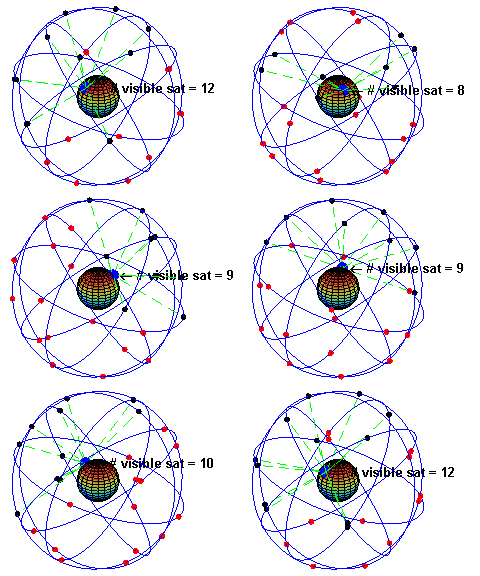
This image represents the 24 satellites used in the now-familiar system known as GPS, or Global Positioning System (public-domain image courtesy of WikiMedia). The earth is shown in the center, with a black arrow constantly pointing to a position 45 degrees north of the equator. The blue rings represent the six orbits, in each of which four satellites circle the planet twice each day.
The time scale is greatly exaggerated, with 30 seconds representing a 24-hour period. The spatial scale, however, is fairly accurate -- Earth is 8,000 miles in diameter, and the satellites orbit about 12,000 miles above the surface.
Dashed, green lines connect the point on the ground to the satellites that would be in a direct line of site from that point. The image illustrates how the number of satellites "visible" at any one time varies from 6 to 12. As explained in more detail on the Smithsonian GPS page, a minimum of four is needed to identify a unique location.
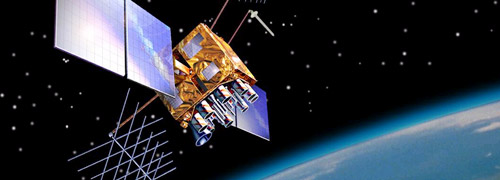
Each GPS satellite is a one-ton, 17-foot, solar-powered vehicle that carries an atomic clock and follows a precisely defined orbit. With just 50 watts of transmitting power, the satellite constantly sends out its location and the precise time. A ground instrument can use the time to determine how far it is from a particular satellite, but this information alone does not define a location, as the direction from the satellite is not known. By calculating the distances from four satellites, however, the overlapping distances define a unique point. Greater numbers of satellites allow for correction of measurement errors.
The GPS technology defines where a receiver is; this is combined with sophisticated geographic information systems (GIS) and routing technology to allow for on-the-spot calculations of pathways from one's current location to a desired destination. Many professional geographers, by the way, were reluctant to use GPS technology because of our love for tradtional, paper maps. As the technology has become more sophisticated -- and convenient -- more geographers have embraced it ... but tend to use it in combination with "real" maps as well!
![]() |
| Source: WikiMedia |
The time scale is greatly exaggerated, with 30 seconds representing a 24-hour period. The spatial scale, however, is fairly accurate -- Earth is 8,000 miles in diameter, and the satellites orbit about 12,000 miles above the surface.
Dashed, green lines connect the point on the ground to the satellites that would be in a direct line of site from that point. The image illustrates how the number of satellites "visible" at any one time varies from 6 to 12. As explained in more detail on the Smithsonian GPS page, a minimum of four is needed to identify a unique location.Each GPS satellite is a one-ton, 17-foot, solar-powered vehicle that carries an atomic clock and follows a precisely defined orbit. With just 50 watts of transmitting power, the satellite constantly sends out its location and the precise time. A ground instrument can use the time to determine how far it is from a particular satellite, but this information alone does not define a location, as the direction from the satellite is not known. By calculating the distances from four satellites, however, the overlapping distances define a unique point. Greater numbers of satellites allow for correction of measurement errors.
The GPS technology defines where a receiver is; this is combined with sophisticated geographic information systems (GIS) and routing technology to allow for on-the-spot calculations of pathways from one's current location to a desired destination. Many professional geographers, by the way, were reluctant to use GPS technology because of our love for tradtional, paper maps. As the technology has become more sophisticated -- and convenient -- more geographers have embraced it ... but tend to use it in combination with "real" maps as well!
![]() |
| LEARN MORE AT GPS.GOV |
Thursday, February 10, 2011
Feb 11: H.H. Richardson School, North Easton
42° 03' 24" N
71° 06' 26" W
Learn more about Lat/Long (including how to look them up by address)
The EarthView team is pleased to be returning to Richardson School, named for a 19th-Century architect. It will be Dr. Domingo's first EarthView program as a grandpa, and the Richardson fourth graders will have an opportunity to see photos of a brand-new geographer!
71° 06' 26" W
Learn more about Lat/Long (including how to look them up by address)
The EarthView team is pleased to be returning to Richardson School, named for a 19th-Century architect. It will be Dr. Domingo's first EarthView program as a grandpa, and the Richardson fourth graders will have an opportunity to see photos of a brand-new geographer!
Subscribe to:
Comments (Atom)